Directions
Museum Lichtenberg
Türrschmidtstraße 24, 10317 Berlin
info@museum-lichtenberg.de
Tel. +49 30 57 79 73 88 11 +49 30 57 79 73 88 11
Visitor office
If you have any questions for the Museum Lichtenberg, please contact the visitors’ office. The visitor’s office is open Monday through Friday from 11:00 a.m. to 6:00 p.m. The office is also staffed on weekends. You are also welcome to send us an e-mail.
Contact: +49 30 57 79 73 88 11,
aufsicht@kultur-in-lichtenberg.de
Hours
The museum is open Tuesdays through Sundays from 11:00 am to 6:00 pm. Closed on holidays
Admission
Admission to the exhibitions and events is free of charge. For certain events, we reserve the right to charge a fee to cover expenses.
Directions
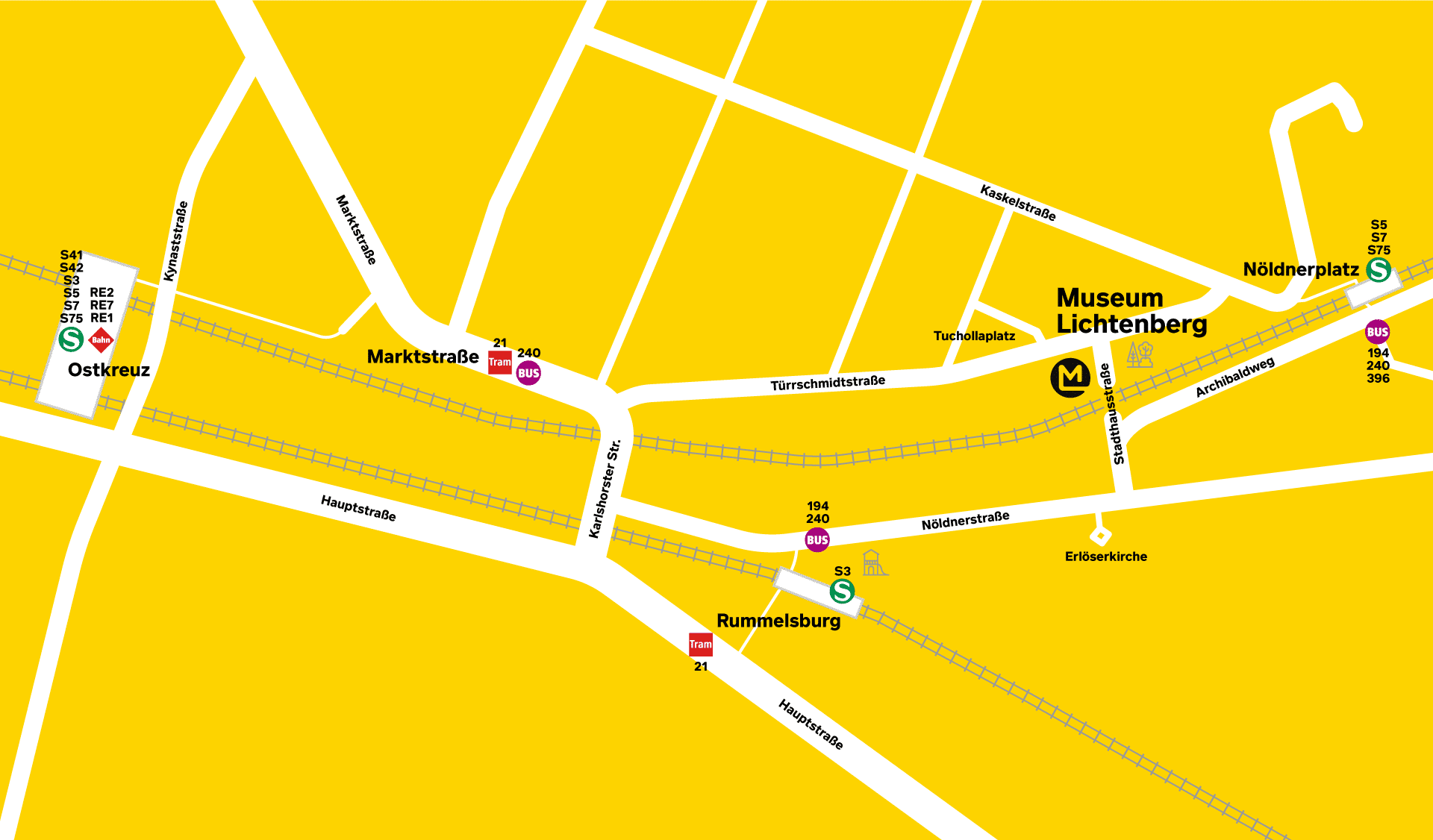
S Nöldnerplatz: S 5, S 7, S 75 | Bus 194, 240 und 396
S Rummelsburg: S 3 | Bus 194 und 240
Stop Marktstraße: Tram 21
Parking
There are parking spaces along the street and in the surrounding area for cars.
The number of parking spaces near the museum is limited.
Two charging stations for electric cars are located next to the museum.
A handicapped parking space is located in front of the main entrance.
There are bike racks in the courtyard with space for about eight bicycles.
Access to the Exhibition
An elevator as well as a guidance and orientation lead to the exhibition spaces.
Texts in plain German or in English can be accessed with a QR code.
Loaner devices/tablets are available.
A tactile orientation plan provides information about the touch and audio stations in the permanent exhibition.
How To Get To the Museum
→ Click to enlarge
Bus and Tram
The museum can be reached by bus or tram via the following stops:
Stop S-Bahnhof Nöldnerplatz with the Bus Lines 194, 240, 396 in ca. 350 Metern
Stop S-Bahnhof Rummelsburg with the Bus Lines 194, 240 in ca. 450 m and the Tram-Line 21 in ca. 500 Metern
Stop Markstraße with the Tram-Line 21 in ca. 450 Metern
Parking
There is a parking space for wheelchair users directly in front of the museum.
Parking is available on the side of the road on Türrschmidtstraße, Stadthausstraße and the surrounding area. Parking near the museum is limited. An Innogy charging station is located on Stadthausstraße.
Bicycle Stands
Bicycle stands for ca. eight bicycles are available in the courtyard.
S-Bahn
The museum can be reached with the S-Bahn via the following stations:
S-Bahnhof Nöldnerplatz (S5, S7, S75)
1
S-Bhf Nöldnerplatz does not have an elevator. There are two flights of stairs.
2
The museum is about 270 meters from the station.
3
It can be reached by foot in about 4 minutes; for people with mobility aids, like a walker, it takes about 10 minutes.
4
Take the right-hand exit of the station to the west toward Kaskelstraße/Türrschmidtstraße.
5
Look to the left and follow Kaskelstraße for 90 meters.
6
The railway on your left can serve as an orientation aid.
7
Cross under the pedestrian underpass and look to the left.
8
Turn left from Kaskelstraße to Türrschmidtstraße.
9
Follow Türrschmidtstraße for 50 meters until you reach Park Türrschmidtstraße.
10
Cross Stadthausstraße. You will reach the museum on your left-hand side after a few minutes.
1
S-Bhf Nöldnerplatz does not have an elevator. There are two flights of stairs.
2
The museum is about 300 meters from the station.
3
It can be reached by foot in about 5 minutes; for people with mobility aids, like a walker, it takes about 10 minutes.
4
Take the left-hand exit of the station to the southeast toward Archibaldweg.
5
Look to the right once you reach the street.
6
The railway bridge that crosses over Archibaldweg can serve as an orientation aid.
7
Now follow this street for ca. 230 meters directly along the railway embankment.
8
You will then reach Stadthausstraße, Archibaldweg ends there.
9
Turn to the right and pass below another railway bridge.
10
Follow Stadthausstraße for ca. 70 meters until it ends.
11
Turn left at the park onto Türrschmidtstraße and cross Stadthausstraße.
12
You will reach the museum on your left-hand side after a few minutes.
S-Bahnhof Rummelsburg (S3)
1
S-Bhf Rummelsburg does have an elevator.
2
This website has up-to-date information about the elevator: http://www.brokenlifts.org/
3
The museum is about 400 meters from the station.
4
You will need ca. 6 minutes to reach it on foot or with an active wheelchair.
5
Exit the station on the right-hand side toward Nöldnerstraße.
6
A playground is located directly at the train station that can serve as a visual and aural orientation aid.
7
Follow Nöldnerstraße for ca. 200 meters in the direction of the church.
8
At the church (Erlöserkirche) is the intersection of Nöldnerstraße – Stadthausstraße. You can cross Nöldnerstraße at a traffic light.
9
Now follow Stadthausstraße, pass below a railway bridge and you will reach the museum on your left-hand side after ca. 100 meters.
S- and Regionalbahnhof Ostkreuz (S41, S42, S3, S5, S7, S75, RE2, RE7, RE1)
The S-Bahn- and Regionalbahnhof Ostkreuz is located ca. 1 km away.
Your Visit To The Exhibition
1
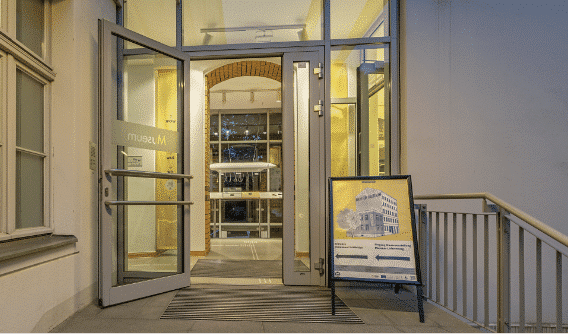
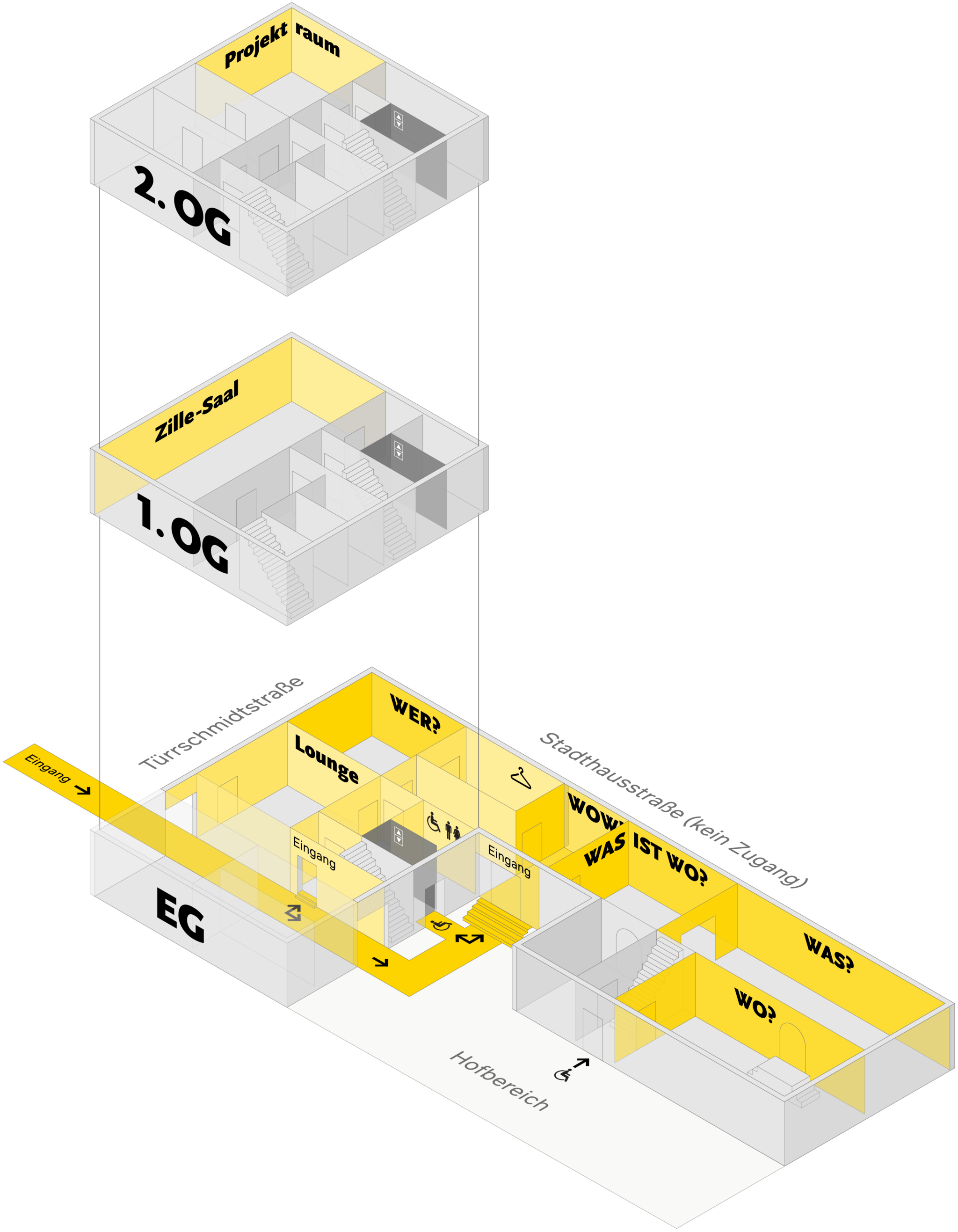
The entrance to the museum at Türrschmidtstraße 24 is a green gate. The gate consists of two doors.
2
The door on the right contains a glass pane with a yellow sign that says “Museum Lichtenberg im Stadthaus”. If the doors to the courtyard are closed, there is a button to open the door on the wall of the building on the right or in the passageway.
3
A tactile floor guidance system leads visitors through the museum and all floors.
4
You can reach the special exhibition in the Zille-Saal on the first floor via the stairs on the left-hand side of the passageway. The rooms of the permanent exhibition can also be reached here.
5
You can reach the main entrance to the museum by walking through the entire passageway.
6
The main entrance is accessible on the left-hand side of the courtyard via four steps.
7
Alternatively, you can use the elevator on the left in the courtyard.
If you choose to enter the museum via the elevator, you will arrive in a hallway. You can reach the exhibition spaces on the right-hand side via the hallway.
8
There is no lobby.
9
Directly across from the main entrance door, a yellow banner with arrows indicates the rooms of the permanent exhibition: WHAT?, WHERE?, WHO? and WOW!.
10
If you have any questions, the staff of the Visitor Service office is at your service.
11
You can reach the coat and bag check room via a small passageway across from the main entrance.
12
The special exhibition is located on the first floor; the project space is located 2nd floor.
You can reach both by elevator or by taking the stairs.
Information On Visiting The Exhibition
1
An accessible bathroom is located on the ground floor. You can find additional restrooms on the first floor. During events in Project Room 307, additional restrooms are also available on the second floor.
2
The routes through the museum have almost no thresholds or obstacles.
3
You can reach the “WO” exhibition space by going up a few steps. Staff members of the Visitor Service can assist visitors with mobility aids to reach this space.
4
A tactile orientation plan is located in the museum. It provides information about the 13 touch stations as well as the four audio stations. The stations are connected with each other via the tactile floor marking guidance system.
5
Many of the exhibits feature writing in Braille.
6
A large part of the exhibition consists of texts. Texts in simplified or English (Media Guide) can be accessed via a smartphone using a QR code. If necessary, you can borrow a table to use while you are in the museum.
7
Text-based information is primarily displayed in high contrast. Unfortunately, not all texts are sufficiently accessible.
8
Due to the variety of exhibition and installation heights, not all exhibits can be seen well by wheelchair users and some texts are difficult to read.
Research On-Site
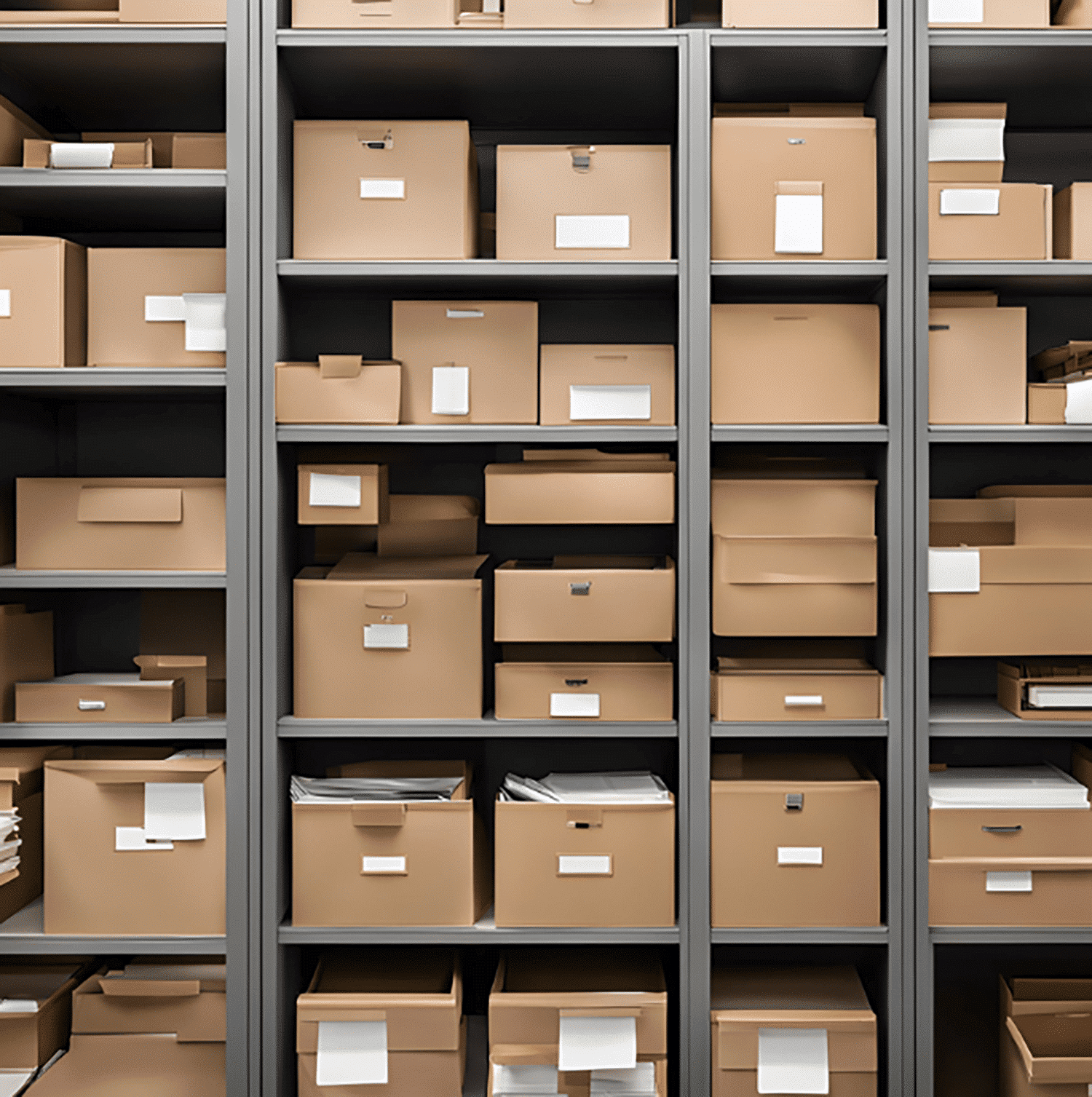
The museum also includes a comprehensive archive with documents, historic records, objects and photos as well as a reference library.
The archive and reference library of the museum serve as the “memory” of the district of Lichtenberg. Here, books, documents, historical records and photos concerning the history of the region from 1650 until today are collected and preserved.
The archive consists of a local history of the district that began in 1978. In 2001, the collections of Heimatmuseum Hohenschönhausen, the local history museum of Hohenschönhausen, were added to those of Lichtenberg.
Today, alongside a comprehensive photo collection, the archive also includes collections on the topics of labor and social history, resistance, forced labor, National Socialism and the Second World War, the German Democratic Republic, construction history and peaceful revolution. It also includes “living” history from people who live in Hohenschönhausen and Lichtenberg in the form of contemporary accounts and family histories, master craftsperson’s diplomas as well as stories from childhood, war or forced labor.
Due to its development from an agricultural to a working-class district, a focus has been placed on the industrial history of Lichtenberg from the beginning of the 20th century until today. It is possible to retrace the history of some businesses over the course of multiple system changes to the present day, such as the Klingenberg power plant or Elektrokohle Lichtenberg, thus allowing for a better understanding of broader historical developments. What’s more, the archive from the former Oskar Ziethen Hospital (now the Sana Klinkum Lichtenberg) is a special collection within the archive. Additional documentation is available on the architecture and monuments from the GDR-era as well as historical collections of newspapers such as the “Lichtenberger Echo” or the “Fortschritt.”
The collection is not generally accessible to the public due to the personal stories and personal data preserved in the archive. Individual material from the archive can be viewed upon request for research projects, thesis work or those interested in local historical research. Please make an appointment via
Archiv- und Sammlungsleiter
Dr. Dirk Moldt
Tel. +49 (0)30 57 79 73 88 18 +49 30 57 79 73 88 18